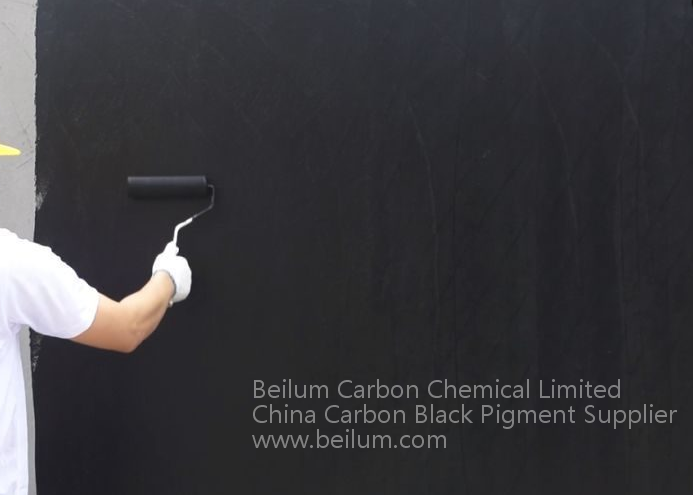
Pigment Carbon Black is mainly used in coatings for construction, automobiles, railway vehicles and ships. It is also used as a tinting pigment in gray and other colored coatings.
Carbon black has high blackness and tinting power and stable price, so it is an indispensable black pigment in the coatings industry. Most coatings now use carbon black as coating processing products.

Important indicator of Pigment Carbon Black for coatings: Carbon Black Blackness
Blackness is the main indicator of carbon black used in coatings. When used for coloring black paints, such as black automotive topcoats, the higher the blackness of the carbon black used, the better. When carbon black is used for color mixing, if the blackness is too high and the amount added is too small, it will easily cause color differences in different batches of paint products, so it is required to use carbon black with a lower blackness.
Two important indicators of Pigment Carbon Black for coatings: Carbon Black Tinting Strength
Tinting power (tinting strength) is the tinting ability of carbon black when white or colored pigments are mixed with carbon black. That is, the degree to which carbon black increases the light absorption of the mixture. This characteristic depends on the dosage ratio of carbon black and pigment and the properties of the carbon black itself. When the dosage ratio is constant, the coloring ability of a certain carbon black is its tinting strength, which is called tinting power in the coatings industry.
When the carbon black particle size is small, the structure is low, and the tinting power is high. However, when the particles are smaller than 20nm, the tinting power no longer increases or even decreases.
Three important indicators of Pigment Carbon Black for coatings: Carbon Black phase
The reduced light reflection of carbon black particles as their particle size decreases will also affect the hue. Surface black coloring with fine-grained carbon black produces a light blue phase, which further enhances the high-chroma visual impression. Coloring with coarse-grained carbon black produces a brown tint.
In addition to particle size, the structure of carbon black will also have an impact on the color tone. Carbon blacks with higher structures and carbon blacks with coarser particles will have similar effects.
The fourth important indicator of Pigment Carbon Black for coatings: Gloss
When the carbon black particle size is reduced or the structure is improved, the oil absorption of carbon black increases, which will increase the viscosity of the coating. Under the same carbon black concentration, the free paint (film-forming substances) on the coating surface decreases, so the gloss decreases. When the oxygen-containing groups or volatile matter on the surface increase, the wettability of carbon black in the binder increases, the viscosity decreases, the free paint on the coating surface increases, and the gloss will increase.
Five important indicators of Pigment Carbon Black for coatings: carbon black dispersion and dispersion stability
The size of carbon black aggregates used in coatings is generally between 20 and hundreds of nanometers, and it is not easy to disperse in paints. The dispersed state of carbon black in paints has a great impact on the performance of coatings. In addition, when carbon black is used in coatings, especially when mixed with other pigments such as titanium dioxide, due to its differences in relative density, aggregate diameter, shape and surface chemistry, carbon black is prone to flocculation, which affects the dispersion stability of the coating.
The coating produced by selecting good pigment carbon black will have the following characteristics:
- Good optical properties such as blackness, tinting power, gloss, hiding power, etc.
- Good liquidity
- Good dispersion stability
- The physical properties of the coating film such as smoothness, gloss retention, mechanical properties (hardness, elongation, impact strength and adhesion), and weather resistance are all improved.